

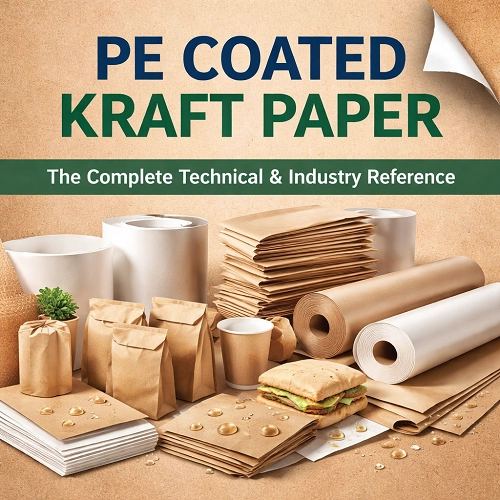
PE Coated Kraft Paper: The Complete Technical & Industry Reference
A Workhorse Material at the Heart of Modern Packaging
Few materials in the packaging industry combine structural toughness, barrier versatility, and cost-effectiveness as elegantly as PE coated kraft paper. By uniting the fibrous strength of natural kraft pulp with the water-repellent and heat-sealable properties of polyethylene (PE), this composite substrate has become an essential component across food processing, e-commerce logistics, construction, and dozens of other sectors worldwide.
The global paper and paperboard packaging market is expected to exceed USD 400 billion by 2030, with functional coated papers accounting for a fast-growing share of that volume. Converters, brand owners, and industrial buyers are under simultaneous pressure to improve barrier performance, reduce product waste, and pivot toward more sustainable substrates — demands that push PE coated kraft paper squarely to the centre of product development conversations.
This guide takes a rigorous, technically grounded look at the material — from pulp fibre chemistry and extrusion coating mechanics through to seal strength testing, sustainability roadmaps, and grade selection frameworks. Whether you are a packaging engineer evaluating a new liner specification or a procurement manager benchmarking supplier capabilities, the following pages offer a definitive reference.
Throughout, we draw on the product expertise and manufacturing data of Targanix TGX Group, a Jiaxing-based specialty paper manufacturer whose PE Coated Kraft Paper range is supplied to customers across food, logistics, construction, and industrial sectors globally.
From Pulp to Coated Sheet: Manufacturing Science
Understanding what PE coated kraft paper actually is at a molecular and structural level is prerequisite to specifying it intelligently. The material is fundamentally a laminate of two chemically distinct worlds: the cellulosic, hygroscopic fibre network of kraft paper, and the hydrophobic polymer film of low-density polyethylene (LDPE) or its higher-performance variants.
The Kraft Base: Fibre Chemistry & Sheet Formation
Kraft paper is produced via the sulfate (kraft) pulping process, where wood chips are digested in a solution of sodium hydroxide and sodium sulfide to dissolve lignin and hemicellulose while preserving long cellulose chains. The result is a pulp with exceptionally high fibre length, crystallinity, and interfibre bonding potential. When formed into a sheet, those long fibres create the characteristic toughness — high tensile strength, tear resistance, and burst strength — that defines kraft paper.
Both virgin kraft (from unbleached softwood) and recycled kraft are used as base substrates. Virgin kraft offers superior mechanical uniformity and cleanliness, making it the preferred base for food-contact and precision industrial applications. Recycled kraft introduces variability in fibre length but reduces raw material cost and embodied carbon, making it appropriate for secondary industrial packaging. Base paper grammage (GSM) is the first specification variable: Targanix PE Coated Kraft Paper is available in kraft base weights from 60 g/m² up to 200 g/m², with the PE coating adding a further 10–40 g/m².
Extrusion Coating: How PE Bonds to Paper
The polyethylene coating is applied through a continuous extrusion coating process. PE pellets are fed into an extruder, melted, and pushed through a flat die, emerging as a molten curtain that is pressed onto the travelling paper web by a chill roll and a pressure roll. Key process variables include:
Melt Temperature
Typically 300–330 °C for LDPE. Adequate heat ensures adhesion via oxidation of the PE surface and fibre penetration.
Line Speed
Faster lines produce thinner coats; slower lines allow deeper fibre impregnation. Balance is critical for coat weight uniformity.
Chill Roll Temp
Controlled cooling sets the crystallinity and surface gloss of the PE film. Lower chill temperatures produce a matte surface.
Nip Pressure
Pressure roll force determines bond strength. Insufficient nip pressure leads to delamination in service.
After coating, the web passes through a corona or flame treatment station where the surface needs to accept printing inks or adhesive lamination. Without surface activation, the low surface energy of PE (~30 mN/m) makes it nearly impossible for water-based inks or adhesives to wet and bond. Corona treatment raises dyne level to 40–50 mN/m, enabling reliable printability.
PE Resin Variants: LDPE, LLDPE, and HDPE
The resin type fundamentally shapes the final barrier and mechanical profile of the coated paper:
| Resin Type | Density (g/cm³) | Flexibility | Moisture Barrier | Typical Use |
|---|---|---|---|---|
| LDPE | 0.910–0.925 | High (soft) | Good | Standard food & industrial liner |
| LLDPE | 0.915–0.940 | Medium | Very Good | Stretch-resistant packaging |
| HDPE | 0.941–0.965 | Low (stiff) | Excellent | Chemical & moisture-critical wrap |
| mLLDPE (metallocene) | 0.900–0.930 | Medium-High | Excellent | Premium heat-seal, precision converting |
Barrier Performance: A Deep Technical Look
The primary commercial value of PE coated kraft paper is its ability to block moisture, vapours, greases, and liquids that would otherwise degrade the kraft substrate or the packaged product. Barrier performance is not a single number but a family of properties that must be matched to the application.
Moisture Vapour Transmission Rate (MVTR)
MVTR, expressed in g/m²/24h, measures how much water vapour permeates through the material under defined conditions (typically 38 °C, 90% RH per ASTM E96 or ISO 2528). For Targanix PE Coated Kraft Paper, MVTR decreases significantly as coating weight increases: a 15 g/m² LDPE coat reduces MVTR to approximately 3–5 g/m²/24h, while a 30 g/m² coat can achieve values below 1 g/m²/24h.
Grease & Oil Resistance (KIT Test)
The KIT test (TAPPI T559) uses a series of castor oil / heptane / toluene blends of increasing aggressiveness (rated 1–12) to probe how well the coated surface resists lipid penetration. Standard PE coated papers achieve Kit 4–8; enhanced formulations with high PE coat weight can reach Kit 10–12, making them suitable for fatty food contact and industrial oil wrapping.
Liquid Barrier & Cobb Sizing
The Cobb test (ISO 535) measures water absorption in g/m² after 60 seconds of surface exposure. Uncoated kraft papers typically exhibit Cobb values of 25–50 g/m². A well-applied PE coat reduces this to under 5 g/m², and often below 2 g/m², confirming near-complete resistance to liquid water absorption.
Tensile Strength & Structural Integrity
The mechanical properties of the composite are governed primarily by the kraft base, with the PE coat contributing elongation resistance and delamination protection. Targanix PE Coated Kraft Papers deliver tensile strength values of 5–10 kN/m depending on base weight and fibre grade, making them suitable for automated high-speed packaging lines where the web must resist tension, slitting forces, and die-cutting without tearing.
Standard Specifications & Custom Parameters
TGX Group manufactures PE Coated Kraft Paper to a broad specification matrix, with nearly all parameters available for customisation. The following table reflects standard production ranges.
| Parameter | Standard Range | Notes |
|---|---|---|
| Base Paper Type | Virgin kraft / Recycled kraft | Bleached white kraft also available |
| Basis Weight (Kraft) | 60–200 g/m² | Custom GSM on request |
| PE Coating Weight | 10–40 g/m² | Single-side (SPE) or double-side (DPE) |
| Roll Width | 100–2000 mm | Slit to custom widths |
| Moisture Resistance | ≥ 95% RH barrier performance | Per ASTM E96 / ISO 2528 |
| Tensile Strength | 5–10 kN/m | Varies by GSM and fibre grade |
| Oil Resistance (KIT) | Kit 4–12 (optional enhanced) | TAPPI T559 |
| Heat Seal Temperature | 120–160 °C | Dwell time and pressure optimise seal |
| Print Compatibility | Flexo, gravure, water-based, UV | Corona treatment required for PE surface printing |
| Colour Options | Natural kraft / White kraft / Dyed | Custom colour on request |
Coating Configuration: SPE vs. DPE
Single-side PE (SPE) coats one face — typically the inner or product-contact side — and is sufficient where moisture only attacks from one direction, such as in tray liners, bag-in-box liners, and sack interleaves. It is lighter and less expensive.
Double-side PE (DPE) coats both faces and is necessary when moisture, liquids, or greases threaten from all sides — common in construction moisture barriers, agricultural ground covers, and outer wrap for metal components susceptible to condensation. All configuration options are available from Targanix's release paper range.
Processing, Printing & Converting
A material specification only has value if the product performs reliably through the entire converting chain: slitting, printing, laminating, die-cutting, heat-sealing, and waste removal. PE coated kraft paper is a capable converting substrate, but each process step has technical requirements that must be respected to avoid defects.
Storage & Conditioning
Before any processing step, rolls should be conditioned at workshop temperature and humidity for a minimum of 24 hours. Kraft paper is hygroscopic; a roll moved from cold storage to a warm print room will develop moisture gradients that cause cockling, misregistration, and curl. Targanix recommends storage in a dry, ventilated area away from direct sunlight, with rolls kept in original packaging until use.
Slitting & Die-Cutting
PE coated kraft paper slit-cuts cleanly with razor or shear-cut slitters. The PE layer's low melting point (~110 °C for LDPE) means that high-friction or dull blades will smear the edge, causing blocking problems in downstream operations. Sharp tooling and appropriate blade clearance (typically 10–15% of material caliper) are critical. For die-cutting, steel-rule dies outperform rotary dies; anti-stick die coatings (PTFE or chrome) help with high-volume runs.
Heat Sealing
The PE layer is the sealing medium. Seal strength increases with temperature and dwell time up to the point where PE begins to degrade (typically above 180 °C for LDPE). The optimal sealing window for Targanix PE Coated Kraft Paper is 120–160 °C at 0.2–0.5 MPa with 0.5–1.0 s dwell time, but this must be validated per coating weight and machine configuration.
Flexographic & Gravure Printing
Without surface treatment, LDPE is essentially non-printable with water-based inks. Targanix can supply rolls with corona pre-treatment to a target dyne level of 42–48 mN/m. The corona treatment effect decays over time: shelf life after treatment is typically 6–8 weeks before re-treatment or lamination is necessary.
Lamination & Composite Structures
PE coated kraft paper is a common component in multi-layer composite packaging — laminated to aluminium foil, non-woven fabrics, or additional paper plies to create structures with combinations of moisture barrier, heat resistance, and puncture resistance. For advanced application development, the Targanix Technology and Quality Control teams provide application engineering support and sample trials.
Industries & Application Map
Across a wide range of industries, PE coated kraft paper occupies niches where neither plain paper nor pure plastic film provides the right balance of properties. The following maps the most commercially significant application areas.
- Food & Beverage
- E-Commerce
- Apparel & Textiles
- Electronics
- Automotive
- Construction
- Agriculture
- Chemical
- Hygiene & Medical
Food & Beverage Packaging
PE coated kraft paper is a go-to material for food-contact secondary packaging: the moisture-resistant layer behind corrugated boxes in produce trays, the inner liner in multiwall flour and sugar bags, and the base sheet in baking papers. Food-grade applications require compliance with FDA 21 CFR (USA) and EU Regulation 10/2011 (Europe) for materials in contact with foodstuffs. Targanix can supply food-grade compliant grades upon request.
E-Commerce & Logistics
The explosive growth of e-commerce has created demand for packaging that can survive multi-modal logistics journeys involving humidity, temperature swings, and physical impact. PE coated kraft paper is used as envelope interliners, void-fill liners, and as the structural layer in padded mailers where the PE coat faces outward to resist ambient moisture.
Construction & Roofing
Among the highest-volume industrial applications, DPE kraft paper is specified for house-wrap moisture barriers, roofing underlayment, and floor protection during construction. Both sides must resist driven rain and condensation while the kraft core provides the tear-resistance needed for stapling and handling on-site.
Agricultural Ground Cover & Mulch
In horticulture and field agriculture, PE coated kraft paper is used as a biodegradable alternative to plastic film for weed suppression and moisture retention. The kraft core degrades in soil over a growing season while the thin PE coat delays water penetration long enough for plants to establish — one of the few applications where controlled degradation of the PE layer is a feature rather than a failure mode.
Sustainability & the Circular Economy
The packaging industry faces intense scrutiny over plastic use. PE coated paper sits at a complex intersection: it is mostly paper, yet the PE coating complicates recyclability in standard fibre streams. Understanding the sustainability trade-offs honestly is essential for procurement decisions aligned with corporate ESG commitments.
The Recyclability Challenge
Standard PE coated kraft paper is not recyclable in conventional paper streams because the PE film must be separated from the fibre before repulping. However, specialist repulping facilities with high-temperature drum pulpers can separate PE from fibre with recovery rates above 90% if the coating weight is below 20 g/m². The resulting PE flake can be recycled into non-food plastic products.
The European Paper Packaging Alliance and CEPI have published guidelines on PE coat weight thresholds compatible with fibre-focused recycling (generally below 5% plastic by weight). Brands operating in the EU should track evolving Extended Producer Responsibility (EPR) frameworks, which increasingly levy fees on non-recyclable coating fractions.
Bio-Based & Compostable PE Alternatives
| Coating Type | Recyclable (Paper Stream) | Compostable | Moisture Barrier | Relative Cost |
|---|---|---|---|---|
| Standard LDPE | No (specialist only) | No | Excellent | Baseline |
| Bio-PE (sugarcane) | No (specialist only) | No | Excellent | +30–50% |
| PLA | No | Yes (industrial) | Good | +40–80% |
| PVOH dispersion | Yes (repulpable) | Partial | Moderate | +20–40% |
| Thin PE (<5 g/m²) | Yes (in most systems) | No | Moderate | Baseline |
Reduced Coating Weight Engineering
One of the most practical sustainability improvements available today is simply optimising coat weight to the minimum required for the application. A packaging engineer who specifies 30 g/m² PE where 15 g/m² would suffice doubles the plastic content unnecessarily. Targanix offers application engineering support to help customers right-size specifications, reducing total plastic use without compromising performance.
Responsible Sourcing & FSC Certification
For sustainability-sensitive applications, kraft base paper should originate from FSC (Forest Stewardship Council) or PEFC (Programme for the Endorsement of Forest Certification) certified sources. Buyers specifying certified material should request chain-of-custody documentation from their supplier.
How to Select the Right Grade
With the breadth of configurations available — base GSM, coat weight, coating side, resin type, colour, and print treatment — selecting the right PE coated kraft paper grade can appear daunting. The following decision framework reduces the specification to a sequence of answerable questions.
Specification Checklist for Enquiries
| Parameter | Question to Answer |
|---|---|
| Application | What product is being packaged, and what is its moisture / chemical sensitivity? |
| Coat Configuration | Single-side (SPE) or double-side (DPE)? PE coat weight range? |
| Dimensions | Required roll width and sheet size? Roll diameter or sheet count? |
| Mechanical Spec | Minimum tensile, tear, and burst strength required? |
| Converting | Will material be printed, heat-sealed, laminated, or die-cut? |
| Food Contact | Is food-grade compliance required? Which regulatory framework (FDA / EU)? |
| Volume | Annual volume estimate in tonnes or km of roll? |
| Sustainability | Are FSC certification, recyclability, or bio-based resin requirements needed? |
About Targanix TGX Group
Targanix (TGX Group) is a Jiaxing-based specialty paper manufacturer with deep expertise in release papers, self-adhesive materials, and functional coated papers. Headquartered at First Floor, No. 358 Fengwu Road, Xincheng Town, Xiuzhou District, Jiaxing City, Zhejiang Province, the company supplies customers across food & beverage, logistics, construction, agriculture, and industrial sectors worldwide.
The Targanix product range encompasses:
- PE Coated Kraft Paper
- CCK Release Paper
- PET Release Film
- Glassine Release Paper
- Hygiene Release Paper
- Self-Adhesive Materials
- Speciality Papers
TGX Group maintains strict quality control procedures, with in-house testing for coat weight uniformity, moisture barrier performance, tensile properties, and seal strength. Custom specifications are developed through a structured sampling and trial process, with technical support from application engineers throughout product qualification.
The company's service offering includes flexible order sizes — from small batch custom trials to large-volume factory procurement — with reliable lead times and global shipping capabilities. Latest industry news and company developments are published regularly on the Targanix website.
For direct enquiries, contact the Targanix team via info@targanix.com or by phone at +86 18857360324.


